Insight
ISO 14001:2026 Is Published. Your Transition Starts Now.
On April 15, 2026, the International Organization for Standardization (ISO) published ISO 14001:2026 — the most significant revision to the environmental management system (EMS) standard since the 2015 edition. For the 670,000 plus organizations certified worldwide, the three-year transition clock is now ticking.
ISO 14001:2026 does not reinvent the framework — it sharpens it. Six clarifying changes, one genuinely new clause and a fully integrated climate-change requirement now define what every certified EMS must demonstrate. This article is the first in an ABS Quality Evaluations (ABS QE) insight series covering what changed, what stayed and what audit-ready organizations are doing right now.
The Transition Window: 36 Months, Starting Now.
ISO and the Global Accreditation Cooperation (Global ACI), formerly the International Accreditation Forum (IAF), have drafted the transition requirements, expected to be published in mid-summer 2026. Once published, the three-year transition window will formally open for all certified organizations. ABS QE will begin delivering transition audits on September 1, 2026 — and as of April 30, 2028, all ABS QE audits will be conducted to the 2026 edition only. The hard deadline for receiving a positive certification decision is April 30, 2029. Any certificate not transitioned by that date will lapse.
| Date | What Happens |
|---|---|
| April 15, 2026 | ISO 14001:2026 published |
| Mid-Summer 2026 | Global ACI transition requirements published; transition window formally opens |
| September 1, 2026 | ABS QE transition audits begin (subject to accreditation approval) |
| April 30, 2028 | Last date to be audited to ISO 14001:2015 — after this, all audits are to ISO 14001:2026 |
| March 1, 2029 | Organizations without a scheduled or complete transition audit are evaluated for withdrawal |
| April 1, 2029 | Certifications without a transition audit in progress are withdrawn |
| April 30, 2029 | Final deadline: transition audit complete with a positive certification decision to avoid any gap in certification history |
The practical implication is clear. Organizations that wait until late 2028 or early 2029 will compete for auditor availability with thousands of others. The organizations that move first this year will set their own pace.
The Six Things ISO 14001:2026 Changes
The Annex SL structure and Clauses 4–10 remain intact. An organization with a mature, well-run EMS does not need to rebuild its system — it needs targeted updates in six specific areas. Annex A guidance has also been substantially expanded to support clearer, more consistent interpretation across all sectors.
- Climate Change Integration (Clauses 4.1, 6.1): The 2024 climate change amendment (Amd 1:2024), already mandatory for ISO 14001:2015-certified organizations, has been fully integrated into the 2026 edition. Climate change must now be considered when determining organizational context and when identifying risks and opportunities. The revision extends this requirement to biodiversity, ecosystem health, pollution levels and natural resource availability — and these factors must flow into objectives, risk registers and operational controls.
- Biodiversity as a Named Aspect (Clause 6.1): For the first time, biodiversity appears explicitly in the standard. Organizations must consider whether their operations meaningfully impact local ecosystems — through land use, water consumption, chemical discharge, lighting or noise — and document the assessment either way. This is not a requirement to commission ecological studies; it is a requirement to show the thinking.
- Life-Cycle Perspective Expansion (Clauses 6.1.2, 8.1):Where the 2015 edition introduced life-cycle thinking, the 2026 edition expects it to show up in scope, in aspects and in operational controls. Upstream (suppliers, raw materials, logistics, packaging) and downstream (product use, distribution, end of life) are no longer optional considerations — they are part of the EMS scope.
- Leadership Accountability (Clauses 5.1, 9.3): Top management must demonstrate active accountability for EMS effectiveness. The revision reinforces that leadership commitment cannot be delegated. Management review (9.3) now requires explicit discussion of environmental performance trends, climate and biodiversity progress, and the status of EMS changes.
- Change Management (New Clause 6.3): Clause 6.3 is the only genuinely new clause in the 2026 revision. It requires organizations to plan and control changes that could affect the intended outcomes of the EMS — operational, organizational, technological, supplier or regulatory. Organizations running an integrated management system with ISO 9001:2015 will recognize this requirement; standalone ISO 14001 organizations will need to develop the process.
- Supply Chain & Performance Indicators (Clauses 8.1, 9.1): Operational controls now extend beyond "outsourced processes" to "externally provided processes, products and services." Suppliers, contractors, logistics providers and service providers are squarely inside the EMS scope. Performance indicators must be measurable, trended over time and tied to significant aspects and major objectives.
Organizations that have already addressed the 2024 climate amendment have a head start. Those that have not yet addressed it now have a deadline and a defined readiness path.
How the ABS QE Transition Audit Works
Your transition can happen in a single visit, combined with your next scheduled surveillance or recertification audit. No stand-alone transition event is required.
- Additional audit time: 0.5 to 1.5 audit days per location (one-time), depending on size and complexity.
- Dual-standard window: Until April 30, 2028, organizations may be audited to either ISO 14001:2015 or ISO 14001:2026.
- Requoting: Existing ISO 14001:2015 clients will be requoted prior to their transition audit to confirm the correct time allocation. Contact your ABS QE account representative to initiate the process.
- Audit focus: ABS QE auditors will evaluate conformance to the new requirements, with particular attention to the six areas of change above.
New to ABS Quality Evaluations?
Organizations seeking first-time certification or transferring from another certification body can certify directly to ISO 14001:2026, building to the current standard from the start.
Why ABS Quality Evaluations?
- Audit-ready tools from day one. ABS QE has published the EMS Ready toolkit which includes an At-a-Glance Cutsheet, a comprehensive Transition Roadmap, and a Self-Assessment Tool, so you can start planning with practical guidance, not generic summaries.
- Sector depth where it counts. The strengthened requirements around climate, biodiversity, supply chain controls and life-cycle perspective hit hardest in energy, maritime, oil & gas, manufacturing and industrial operations. As part of the ABS Group family, ABS QE’s auditors understand these industries from the inside.
- An integrated services ecosystem. ABS QE connects you to the broader ABS Group capability set, including GHG verification (ISO 14064-1), sustainability assessments, supply chain evaluations and cybersecurity so your EMS transition reinforces your broader operational resilience, regulatory compliance and sustainability objectives.
- Combined audit efficiency. Combine your ISO 14001:2026 transition with other management system audits, including ISO 9001, ISO 45001, ISO 50001, RCMS and RC14001, minimizing disruption and total audit cost.
ISO 14001:2026 Transition Roadmap
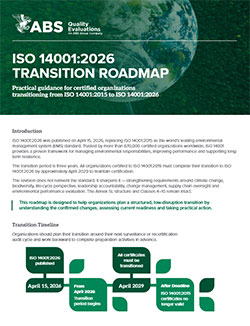
Access our comprehensive ISO 14001:2026 Transition Roadmap and plan a structured, low-disruption transition to the world's leading environmental management system standard. This 9-page guide covers all six confirmed changes, a clause-by-clause gap assessment framework, a maturity model for scoring your current EMS, a sample action plan with priorities and owners, a pre-transition checklist, and a suggested four-phase timeline running from now through April 2029.
Request the Roadmap
About ABS Quality Evaluations
ABS Quality Evaluations, Inc. (ABS QE) is a subsidiary of ABS Group of Companies, Inc. (www.abs-group.com). As a world-leading certification body, ABS QE works with companies to improve the performance of their business, systems, people and supply chains through management systems certification, verification, training and assessments, including supply chain and cybersecurity. ABS QE’s global network of auditors plays a crucial role in helping organizations achieve business excellence and obtain the necessary certifications to get products and services to market.