ISO 14001 Overview

Discover how following the ISO 14001 environmental management systems standard can help businesses minimize their environmental footprint.
What is ISO 14001?
ISO 14001:2026 is an internationally recognized standard for environmental management that details how to design and implement an effective system to manage an organization’s environmental responsibilities. It provides practical tools that organizations can use to improve resource efficiency, reduce waste and reduce cost—all of which lead to better operational performance alongside more sustainable business practices. The standard also makes it possible to compare the environmental performance of different corporations, offering specific definitions for the practices, procedures and processes by which an organization can be measured.
Benefits of ISO 14001
Organizations that use ISO 14001 can achieve much more than the standard’s stated goals of environmental protection. By taking a structured approach to addressing environmental concerns, businesses typically see tangible benefits such as cost savings that lead to a better bottom line, such as:
Reduced Resource Consumption and Waste: By systematically monitoring resource consumption and pollution emission levels, an organization can identify opportunities to limit waste.
Lower Operating Costs: One byproduct of reduced resource usage and waste can be lower supply and disposal costs that directly benefit the bottom line. In addition, simply having a compliant EMS can potentially reduce public liability insurance costs as well.
Higher Conformance to Regulatory Requirements: The framework set forth in ISO 14001 can help an organization demonstrate compliance with globally applicable environmental regulations, such as the Eco-Management and Audit Scheme III (EMAS) in the EU.
Increased Competitiveness: With better internal controls set for reducing environmental risks, organizations can strengthen their ability to compete against companies without such mechanisms in place.
Stronger Reputation and Recruitment: With a stated commitment to environmental protection, organizations can improve public perceptions, thereby attracting new customers and employees.
Lower Trade Barriers: By adhering to this standard, organizations can demonstrate a heightened sense of responsibility for the global community that can break down trade barriers and attract more business opportunities.
Improved Risk Profile: With the tools provided in ISO 14001, organizations can gain the ability to more consistently identify, assess and manage environmental risks, which helps protect them from potential liabilities and disruptions.
How Does ISO 14001 Work?
ISO 14001:2015 uses the Plan-Do-Check-Act (PDCA) model for establishing a compliant environmental management system (EMS) that addresses environmental risks and opportunities. The PDCA cycle requires organizations to:

Establish an Environmental Policy
Establish an environmental policy that outlines your organization’s commitment to environmental management.

Set Environmental Objectives
Set environmental objectives and targets that align to your organization’s goals and priorities.

Identify Aspects and Impacts
Identify your organization’s environmental aspects and impacts.

Implement Operational Controls
Implement operational controls to minimize environmental impact.

Establish Procedures
Establish procedures to monitor and measure your environmental performance, tracking progress toward stated goals and objectives.

Train Staff
Train staff to understand their roles and responsibilities in the EMS and know how to implement its procedures and controls.

Conduct Periodic Reviews
Conduct periodic reviews of your EMS to identify opportunities for improvement and make changes as necessary to enhance environmental performance.
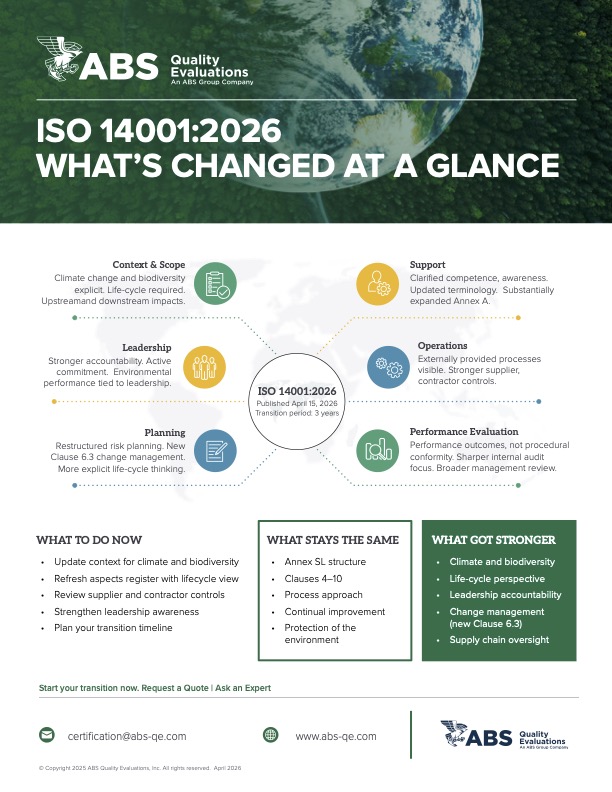
ISO 14001:2026 At a Glance
What's Changed and What It Means for Your EMS
Get a clear, concise overview of what's new in ISO 14001:2026 and how to start planning your transition with confidence.
ABS QE Services

Certification Services
Achieving ISO 14001 Certification will help your organization verify your commitment to key stakeholders to better minimize risk, improve operational efficiency and maximize the value of your operations and assets.

Training Services
Gain the knowledge and skills necessary, through our training programs, to perform internal audits of your organization’s environmental management system based on the ISO 14001:2026 requirements.
FAQs
Who should follow the ISO 14001 standard?
Organizations of any size that wish to manage their impacts in the face of changing environmental conditions can benefit from following ISO 14001.
Who should follow the ISO 14001 standard?
Why is ISO 14001 important?
ISO 14001 helps organizations take a proactive approach to protect the environment from harm and degradation, requiring sustainable resource use and climate change mitigation practices. It requires that an organization manage all environmental issues relevant to its operations, including air pollution, water and sewage issues, waste management and soil contamination.
Why is ISO 14001 important?
What changes were made in the latest revision?
ISO 14001:2015 requires a greater commitment from an organization’s leadership, with environmental management taking a prominent role in its strategic direction. It also directs organizations to focus on a broader life cycle approach, to keep environmental concerns in consideration from product development to end-of-life.
What changes were made in the latest revision?
What is the difference between ISO 9001 and ISO 14001?
While both are important, internationally recognized standards, they have different purposes and structures. ISO 9001 focuses on quality management systems that help organizations improve products and services, but ISO 14001 focuses on establishing an environmental management system that aims to protect the environment.
What is the difference between ISO 9001 and ISO 14001?
Where can I get help getting ISO 14001 certification?
Organizations must undergo an audit by an accredited certification body to verify compliance with the standard. ABS QE has extensive experience combined with a robust portfolio of services to help guide organizations on their information environmental management system certification journey.
Where can I get help getting ISO 14001 certification?