Insight
Context, Climate and Interested Parties: The Three Decisions That Reset Your QMS Boundary in ISO 9001:2026

Three changes in the Final Draft International Standard (FDIS) ask organizations to make context decisions explicit. The decisions themselves are not new — but documenting them is.
The opening clauses of any ISO management system standard set the boundary. They ask, in effect: what is this management system about, and what falls inside it? The 2015 edition of ISO 9001 did this through clauses 4.1 (context) and 4.2 (interested parties). The FDIS revises both — and adds a third decision point at the intersection.
The changes are subtle in wording but consequential in practice. Each turns a previously implicit decision into one that must be documented and defensible.
Decision One: Is Climate Change Relevant to Your Context?
Clause 4.1 of the FDIS adds an explicit requirement to determine whether climate change is a relevant context issue for the Quality Management System (QMS). This is one of the most discussed changes in the revision and also one of the most misunderstood.
The clause does not require organizations to make climate change a major QMS focus. It does not require a climate strategy, a carbon target or a sustainability program. What it requires is a deliberate decision, with documentation: have we determined whether climate is relevant to our QMS context, and what is the basis for our answer?
The answer is rarely "no." For a food manufacturer, supply instability, water availability and transport disruption all have plausible climate connections. For a software firm, climate may be less relevant to product conformity but still relevant to infrastructure resilience and customer expectations. For a field-service provider, weather and infrastructure outages affect scheduling and service delivery.
The most defensible position is a documented context analysis that identifies the climate-related issues considered, identifies those judged relevant and explains the reasoning. The audit risk is not in saying "partly relevant." The audit risk is in saying "no" without showing the work.
Decision Two: Which Interested-Party Requirements Actually Go Through the QMS?
Clause 4.2 in the 2015 edition required organizations to determine interested parties and their requirements. Most certified organizations responded by building a matrix — a list of parties and what they want.
The FDIS adds an explicit step: determining which of those requirements will be addressed through the QMS specifically. The distinction matters. Many interested-party requirements are managed elsewhere — by legal, by HR, by IT security, by procurement. The new wording asks the organization to make that division of responsibility explicit.
In practice, this turns the interested-party matrix from a compliance document into a working artifact. For each row, the auditor can now reasonably ask: is this requirement addressed by the QMS? If yes, where? If no, where is it managed?
Organizations whose interested-party matrix has lived as a static document for years will likely need to revisit it. The good news is that the work is largely re-decisioning, not redesigning. The matrix structure does not need to change; the filtering column does.
Decision Three: Climate as an Interested-Party Requirement
A second change in clause 4.2 notes that interested-party requirements may relate to climate change. This connects the two preceding decisions: climate may not only be a context issue, but it may also be a stakeholder requirement. Customers may have climate-related expectations. Regulators may have climate-related reporting obligations. Investors may have climate-related disclosure requirements that flow through the supply chain.
The audit implication is the same as for the first decision: where climate appears in interested-party requirements, the organization should be able to show its analysis of which of those requirements the QMS addresses, and which are managed elsewhere.
Preparing Without Rewriting
Three practical steps tend to cover most of the gap for organizations preparing in this area:
- Refresh the context analysis. Add a documented determination on climate relevance. State the climate-related issues considered, those judged relevant and the reasoning.
- Revisit the interested-party matrix. Add a column showing which requirements are addressed through the QMS. Be specific about where requirements are managed when they are not.
- Document the reasoning. The FDIS asks for explicit decisions; "explicit" in audit language means "we can show how we decided, not only what we decided."
Watch the On-Demand Webinar
ISO 9001:2026 Is Coming: What's Changing and How to Prepare
On July 16, 2026, ABS QE Global Sustainability Program and Technical Manager Heather Parker walked through every clause changing in ISO/FDIS 9001 — with live Q&A on the technical questions QMS owners are asking most. The full session is now available on-demand.
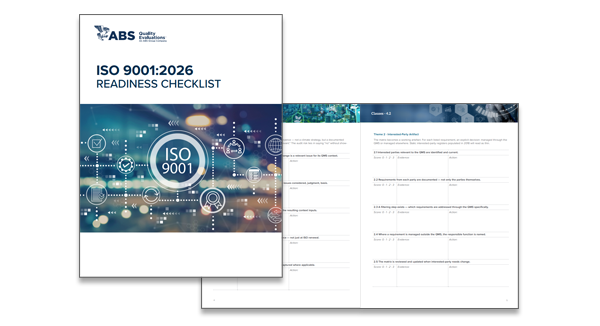
ISO 9001:2026 Readiness Checklist
Download the ABS QE ISO 9001:2026 Readiness Checklist and see how your context, interested parties and QMS boundary decisions measure up before the revision takes hold.
Thirty questions across six themes give you a scored, honest read on where you stand, including whether your context analysis, interested-party matrix and climate-relevance determination would meet the FDIS bar today, and a clear map of where to focus first.
Access Complimentary Resources
About ABS Quality Evaluations
ABS Quality Evaluations, Inc. (ABS QE) is a subsidiary of ABS Group of Companies, Inc. (www.abs-group.com). As a world-leading certification body, ABS QE works with companies to improve the performance of their business, systems, people and supply chains through management systems certification, verification, training and assessments, including supply chain and cybersecurity. ABS QE’s global network of auditors plays a crucial role in helping organizations achieve business excellence and obtain the necessary certifications to get products and services to market.