Insight
Leadership, Culture, and Ethics in ISO 9001:2026 - The Soft Clauses Auditors Will Take Seriously

Quality culture and ethical behavior are entering ISO 9001 explicitly for the first time. The reason is straightforward: when standards stop at policy, they stop short of where quality actually lives.
When organizations describe the "hard" parts of an ISO 9001 audit, they tend to mean process and procedure conformance. The "soft" parts, leadership engagement, organizational culture and ethical behavior historically lived in the margins. Auditors might ask about them, but most of the audit evidence rested elsewhere.
That changes in the FDIS. Clause 5.1.1 of the draft standard adds explicit expectations for top management around three areas: quality culture, ethical behavior, and opportunity-based thinking. Clause 7.3 adds awareness of those same elements to the workforce-level training requirement.
Together, these updates ask organizations to do something they have not been asked to do at this level of clarity before: provide evidence of how leadership shapes the environment in which quality decisions are made.
What "Quality Culture" Means in The Audit Room
A useful working definition: quality culture is the pattern of decisions made when no one is watching and the easy choice would be to compromise.
That is harder to evidence than a documented procedure, but it is not impossible. Likely audit lines of inquiry include:
- How does leadership communicate quality expectations? Is the messaging consistent across operational decisions, not only in formal communications?
- When schedule, cost, and quality come into tension, who resolves the tension, and how?
- Can employees point to recent examples where quality concerns were raised and acted on?
- Is there a documented mechanism for raising ethical concerns, and is there evidence the mechanism is used?
Auditors are likely to triangulate. They will ask leadership how culture is shaped, ask front-line staff what they experience, and look for alignment.
"Ship it Now, Fix the Paperwork Later"
A useful illustration: a production lead under shipment pressure says, "Ship it now, fix the paperwork later." That sentence tells an auditor more about quality culture than any framed policy on the wall. The point is not that anyone speaks that line aloud during an audit. The point is whether the pattern of decisions in the organization, when no one is auditing, would produce that line.
Organizations preparing for the FDIS should think about which decisions tell that story in their own context — supplier escalations, change approvals, document control under deadline pressure, internal audit findings closed too quickly. Auditors will be looking at how those decisions get made, not only how they get documented.
Ethical Behavior Is Now In Scope
Clause 5.1.1 also names ethical behavior explicitly. Among the practical implications:
- The organization is expected to have a way for staff to raise concerns about data integrity, approval shortcuts or pressure to bypass controls.
- The mechanism should be more than a policy. There should be evidence that it works.
- Reporting routes that lead to the same individual who makes the schedule-pressure decisions are unlikely to be effective.
Opportunity-Based Thinking — A Leadership Shift
The third element added at 5.1.1, opportunity-based thinking, connects to the broader risk and opportunity separation in clause 6.1, covered later in Insight 4 of this series.
What leadership is asked to model here is the posture of looking for improvement opportunities rather than only managing downside risk.
In practice, that means management review and operational meetings should be able to point to opportunities identified and acted on, not only problems resolved.
How To Prepare Without Rewriting Policy
Most organizations preparing for the FDIS in these areas do not need new policies. They need documented patterns:
- Leadership messaging logs or summaries that show consistent quality reinforcement
- A documented escalation route for ethical concerns with evidence of use
- Management review notes that capture how culture and ethics are tracked
- Awareness training content updated to cover behaviour, not only knowledge
Awareness should evolve away from "read the quality policy" and toward "here is what you do when you see X." That phrasing change alone often surfaces gaps.
See Where You Stand
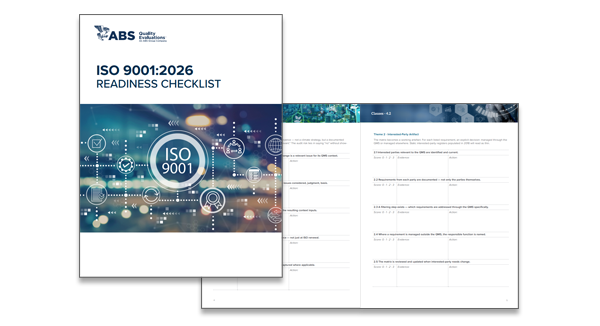
Request the ABS QE ISO 9001:2026 Readiness Checklist below and score your current QMS across the six themes — including how leadership, culture and ethics evidence would hold up in a surveillance audit. Thirty questions, one afternoon, a clear map of where to focus first.
ISO 9001:2026 Readiness Checklist
Download the ABS QE ISO 9001:2026 Readiness Checklist and see how your current QMS measures up before the revision takes hold.
Thirty questions across six themes give you a scored, honest read on where you stand, including how your leadership, culture and ethics evidence would hold up in a surveillance audit and a clear map of where to focus first.
Access Complimentary Resources
About ABS Quality Evaluations
ABS Quality Evaluations, Inc. (ABS QE) is a subsidiary of ABS Group of Companies, Inc. (www.abs-group.com). As a world-leading certification body, ABS QE works with companies to improve the performance of their business, systems, people and supply chains through management systems certification, verification, training and assessments, including supply chain and cybersecurity. ABS QE’s global network of auditors plays a crucial role in helping organizations achieve business excellence and obtain the necessary certifications to get products and services to market.