Insight
Climate Change and Biodiversity in ISO 14001:2026 - What Clauses 4.1 and 6.1 Now Require
For more than a decade, ISO 14001 acknowledged climate change in the margins. The 2024 amendment moved it into the body of the standard. The 2026 revision integrates it fully — and adds biodiversity, ecosystem health, pollution levels, and natural resource availability as named environmental conditions that organizations must consider.
Clause 4.1 — Climate as a Context Issue
Climate change is now treated as a baseline external issue every certified organization must analyze. The question for auditors is not whether climate has been mentioned somewhere in your context analysis — it is whether your organization has documented how climate-related conditions affect, and are affected by, the organization's purpose and strategic direction. That assessment must be specific. Generic statements no longer pass.
What Auditors Will Look For: Context Registers
Expect auditors to ask whether your context analysis explicitly addresses physical climate risk (extreme weather, water stress, sea-level rise where relevant), transition risk (regulatory, market, technology shifts), and dependencies (energy, water, materials affected by climate-driven supply disruption). Documented thinking — even brief — is the deliverable.
Clause 6.1 — Biodiversity as a Named Aspect
The 2026 edition requires organizations to consider biodiversity as part of environmental aspects identification. The threshold question: do your operations have any meaningful impact on local ecosystems? If the answer is no, document the assessment and move on. If the answer is yes, then biodiversity impacts must appear in the aspects register, in risk assessments, and in objectives.
What Auditors Will Look For: Biodiversity Assessments
Auditors will look for evidence that the assessment was performed, — not necessarily an ecological study. A documented review by qualified internal staff, a site walk that considers habitat and water bodies, and a risk-based decision logged in the Environmental Management System (EMS) is sufficient for most non-impact organizations. Sites with material biodiversity exposure (extractive industries, large land footprints, water-dependent operations) should expect deeper expectations.
Closing the Gap: Practical Steps
- Update the context analysis tool you already use (SWOT, PESTLE, or similar) to add explicit rows for climate, biodiversity, ecosystem, pollution, and resource availability.
- Walk every aspect in your aspects register past the four-condition test (climate, biodiversity, pollution, resource) and document either the impact or the rationale for non-materiality.
- Brief top management on the updated context e.g. leadership accountability under Clause 5.1 expects executives to know what changed.
- Capture the changes in your transition log so the auditor can trace the revision.
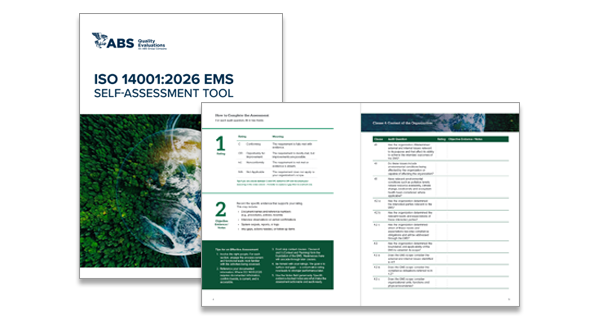
ISO 14001:2026 Self-Assessment Tool
Access our comprehensive ISO 14001:2026 EMS Self-Assessment Tool and surface every gap in your current management system before your transition audit begins.
This clause-by-clause diagnostic covers approximately 145 audit-ready questions across Clauses 4–10, scored on the same four-tier scale (C/OFI/NC/N/A) an ABS QE audit will use and includes an evidence-and-notes column, a priority-action summary, and a nonconformities register.
Access Complimentary Resources
About ABS Quality Evaluations
ABS Quality Evaluations, Inc. (ABS QE) is a subsidiary of ABS Group of Companies, Inc. (www.abs-group.com). As a world-leading certification body, ABS QE works with companies to improve the performance of their business, systems, people and supply chains through management systems certification, verification, training and assessments, including supply chain and cybersecurity. ABS QE’s global network of auditors plays a crucial role in helping organizations achieve business excellence and obtain the necessary certifications to get products and services to market.